Choosing an LED grow light can be confusing with all the options, numbers, and marketing claims out there. Many growers worry about wasting money or hurting their plants by picking the wrong wattage. This guide makes things easy. You’ll learn how to figure out exactly how much light your plants need, what specs matter, and how to use the Power, Color, and Cost (PoCoCo) method to make smart choices.
Table of Contents
- Introduction: Why LED Grow Light Wattage Matters
- Understanding True Wattage vs. Marketing Claims
- Meet the PoCoCo Method: Power, Color, Cost
- Step-by-Step: Calculating Your Required Power
- PPFD & DLI Explained: The Science Behind the Numbers
- Spectrum 101: White vs. Multi-Band LEDs
- Choosing the Right Fixture: Key Buying Tips
- Real-World Wattage Examples for Popular Grow Setups
- Common Grow Light Mistakes (and How to Avoid Them)
- Conclusion: Fine-Tuning for Your Best Harvest
By the end, you’ll know how to pick the right light for your grow space and avoid common mistakes. For quick tips, just look for the “Bottom line” at the end of each section.

Why Wattage Matters (and What It Really Means)
Wattage gets tossed around a lot in LED lighting, but not all watts are created equal. Many manufacturers list "equivalent wattages" (like 1000W) that don’t reflect actual power draw. What you want is actual wattage – the real electricity the light consumes – because that’s a solid proxy for light intensity if you’re comparing high-quality LEDs.
Dr. Bruce Bugbee’s research shows that light intensity (not spectrum) is the key driver of plant growth and yield, especially for flowering crops like cannabis. Light intensity is typically measured in PPFD (µmol/m²/s), but for practical purposes, you can think in terms of watts per square foot (W/ft²):
Plant Type and Recommended Wattage Table
| Crop Type | Recommended Wattage (W/ft²) |
|---|---|
| Leafy Greens / Herbs | 10-20 |
| Vegetative Stage for Bud | 20-30 |
| Tomatoes (Flowering / Fruiting) | 40-50 |
| Flowering Stage for Bud | 30-50 |
Bottom line: To hit optimal light levels for flowering, aim for 30 to 40 watts per square foot with a high-quality LED. Plants like buds thrive at around 800 to 1000 PPFD, especially during bloom. Lower-end lights may need more watts to reach the same intensity. And remember—shorter light cycles mean you’ll need more intensity to hit your daily light goals.
The PoCoCo Method: Power, Color, Cost
Forget specs you don’t understand. The PoCoCo Method, developed by growers who got tired of bad advice, helps you focus on just three things: Forget specs you don’t understand. The PoCoCo Method, developed by growers who got tired of bad advice, helps you focus on just three things:
- Power: Match your light’s output (watts or PPFD) to your garden’s size and plant type. Focus on your actual needs—not marketing claims. We’ll cover a simple formula next.
- Color: Choose a full-spectrum LED with all key wavelengths. Spectrum shapes plant quality, but intensity drives yield. Skip “blurple” lights for best results.
- Cost: Balance price, efficiency, and reliability. Prioritize reputable brands with at least a 3-year warranty. Quality lighting saves money and stress over time.
Bottom line: The idea behind PoCoCo is like having a trusted grow shop employee walk you through your setup. By focusing on Power, Color, and Cost, you ensure you’re covering the essentials. You start with how much light you actually need, make sure the light’s spectrum is appropriate, and verify that it’s a good value (quality components, high efficiency, and backed by a warranty).
Step-by-Step: How Much Power Do You Need?
Now let’s get practical with the first “Po” (Power). How do you figure out how many watts of LED lighting you need for your grow space? Just follow these steps:
1. Measure Your Grow Area
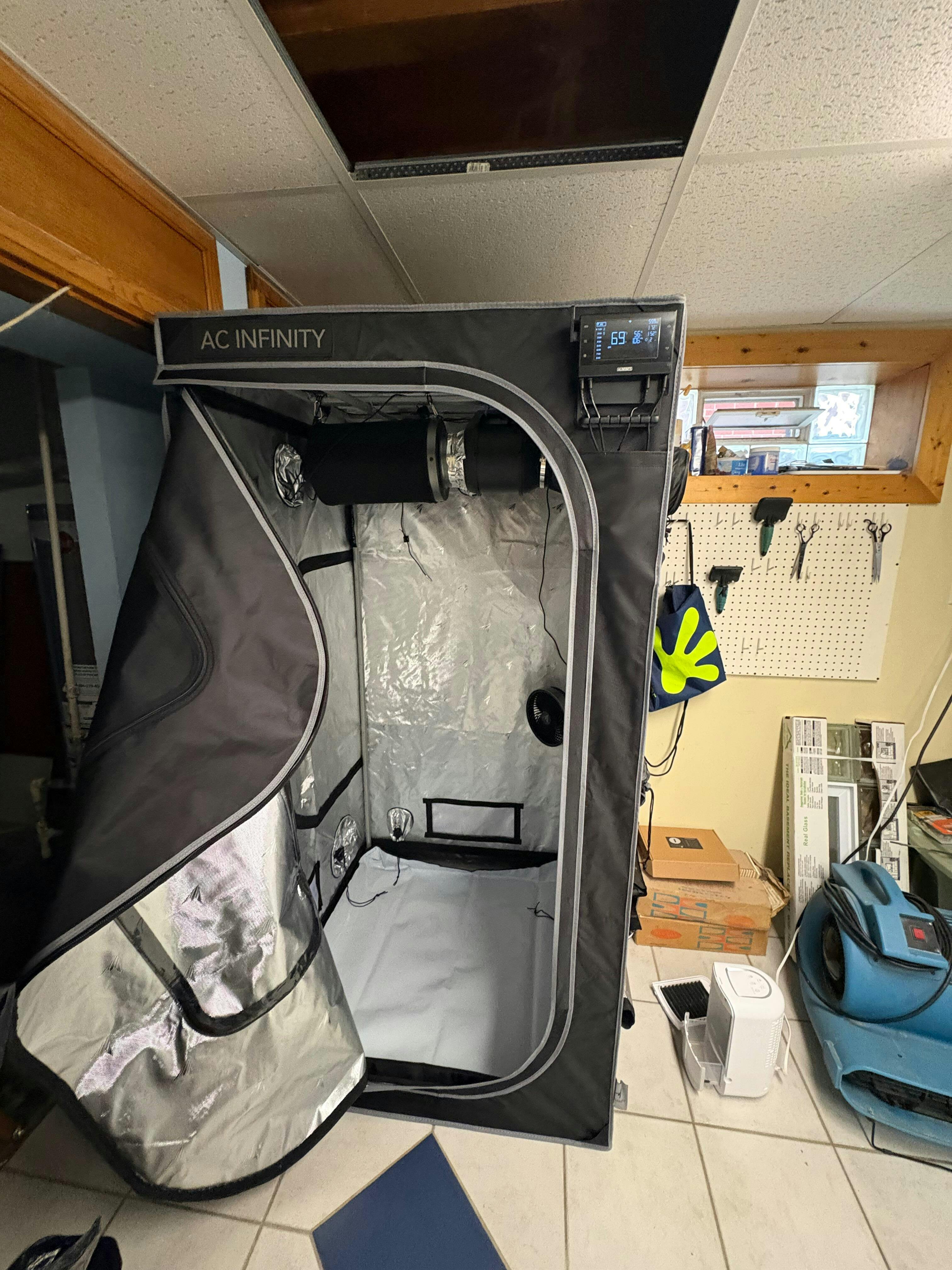
Multiply length by width to get your grow space in square feet. Only count where plants will actually grow. For example, a 4’ x 4’ tent = 16 square feet of grow area.
2. Choose Your Target Intensity
Use the recommended watts per square foot or PPFD for your plant type and stage. Flowering cannabis needs more light than lettuce or seedlings.
3. Apply the Formula
Watts = Area × Target W/ft². This gives you the total LED wattage you need.

Example: For a 4×4 tent in flower, let’s say you target 35 W/ft² (middle of the 30–50 range). Area 16 ft² × 35 W/ft² = 560W of actual LED power required.
Another example: If you had a 3×3 ft (9 ft²) space for flowering, and you aim high at 40 W/ft², you’d need ~360W.
Bottom line: Always calculate using the actual wattage pulled from the wall, not the inflated “equivalent” wattage. A light sold as 1000W but drawing 150W only counts as 150W. You may need several fixtures to hit your target. This approach gives you a realistic starting point based on your plants' needs, not marketing claims. Once you know your total watts, you can shop smarter for lights that truly deliver.
Understanding PPFD and DLI (Daily Light Integral)
At this point, you might be wondering: instead of talking about watts, why not talk about light in scientific terms like PPFD and DLI? Let’s quickly break those down, because they’re the why behind the watt recommendations:
- PPFD (Photosynthetic Photon Flux Density) is the intensity of plant-usable light hitting each square meter per second, measured in μmol/m²/s—basically, plant brightness. Most indoor flowering plants thrive around 800–1000 μmol/m²/s at canopy level, with higher numbers only beneficial if you’re optimizing everything else, like CO₂ and nutrients. For most, 1000 μmol/m²/s is a practical upper limit.
- DLI (Daily Light Integral) measures the total amount of light plants receive each day, summing up all those PPFD seconds over your photoperiod, and is measured in mol/m²/day. Buds, for example, thrive at a DLI of 35–45, with 40+ being ideal for heavy yields. You can hit your DLI target by increasing light intensity (PPFD), lengthening the light cycle, or both. Flowering plants, limited to 12 hours of light, need higher PPFD to reach their DLI, while vegetative or autoflowers can use longer light periods with lower PPFD to achieve the same result.
Bottom line: Wattage → photons (PPFD) → daily photons (DLI) → plant growth. We use watts per area as a shortcut, but it’s really about getting your DLI into that sweet spot. You can achieve a given DLI by either cranking up intensity or running lights longer (or both). For photoperiod plants in the flowering stage, you’re capped at 12 hours of light, so you naturally need higher PPFD (more W/ft²) to reach the ideal DLI. In vegetative or autoflower grows, where you might run 18–20 hours of light, you can afford a slightly lower PPFD and still hit the daily total – hence vegetative stages often use fewer W/ft², or you can dim your lights and run them longer. Use photoperiod to your advantage: a longer light schedule can compensate for lower intensity, and vice versa.
Light Spectrum: White vs. Multi-Band
We’ve hammered on intensity, but what about spectrum (the “Color” in PoCoCo)? Spectrum does matter – it can influence plant morphology, terpene profiles, and other quality factors – but it’s secondary to quantity. As Dr. Bugbee often emphasizes, spectrum shapes the plant, but intensity drives the yield. That said, you generally can’t go wrong with a full-spectrum white LED for all stages of growth. These LEDs emit a broad range of wavelengths (similar to natural sunlight) and usually include a balance of blue, green, and red light. They often have additional deep-red or far-red chips to round out the spectrum. Full-spectrum lights are great “all-purpose” solutions and make it easy to see and diagnose your plants (and they’re easier on the eyes compared to the old blurple lights).
So, which spectrum is best? While “blurple” fixtures were designed to provide just the wavelengths chlorophyll absorbs, modern research shows that including green and a broader mix of light leads to healthier, more productive plants. Full-spectrum LEDs typically include a balance of blue to keep plants compact, lots of red for efficient photosynthesis, some green for canopy penetration, and a touch of far-red to encourage flowering.
Most importantly, avoid overloading on blue light. While blue is essential, too much can reduce yield. Most reputable LEDs are already designed to provide an optimal mix, usually with 10–20% blue, at least half red, and some green/yellow. Far-red and UV are not strictly necessary unless you have very specific goals in mind.
Bottom line: intensity is priority #1, spectrum is a useful fine-tune. Get enough photons in the right range, and your plants will reward you. Once that’s covered, make sure you have a decent spectrum for healthy development, which usually means a quality full-spectrum LED unless you have specific reasons to go with something else.
Choosing the Right Light
By now you know how many watts (or PPFD) you need and what spectrum to look for. How do you pick the specific light fixture(s) to buy? Here are some tips to ensure you get a winner:
- Avoid sketchy brands: Stick with brands reviewed by growers or tested by third parties—ignore “too good to be true” Amazon deals and flashy model names.
- Check actual specs: Focus on true watt draw and μmol/J efficacy, not just “equivalent to 1000W HPS.” Make sure the fixture’s coverage matches your grow area.
- Prioritize efficiency and build quality: Choose LEDs with high efficacy (2.2–3.0 μmol/J) and quality components for cooler running, better yield, and longer life.
- Coverage and modularity: For larger spaces, use multiple fixtures for even coverage and flexibility. Two smaller lights can outperform one big one in adjustability.
- Dimming and control: Pick LEDs with dimmers or spectrum controls so you can dial in the perfect intensity for each growth stage and extend fixture lifespan.
- Warranty and support: Go for brands offering at least a 3–5 year warranty and solid support—worth paying a bit more for peace of mind and easier repairs.
- Read grower feedback: Look for real-world results in forums or YouTube, not just Amazon. Pay attention to watt draw, heat, and PAR/PPFD readings.
- Watch out for misleading specs: Don’t confuse marketing numbers for real performance. A “1000W LED” that draws 150W isn’t equal to a 1000W HPS. Seek PPFD maps for actual light distribution.
-
Fit for space: Make sure the fixture fits physically in your grow space and can be hung at the right height—bar styles spread light, boards are compact but may have hotspots.
Bottom line: Choose a light that meets your calculated power needs, delivers a good spectrum, and is efficient and reliable. If you do that, you’ll set yourself up for success.
Realistic Examples
To tie it all together, here are some realistic example scenarios with wattage guidelines. These assume quality LED lights (around 2.2–2.7 μmol/J efficacy). There’s a range because of different strains/crops and desired aggressiveness of lighting:
| Grow Area | Light Demand | Wattage Range (Actual Draw) |
|---|---|---|
| 2x2 (4 sq ft) | Veg / Flower | 80 to 160 W |
| 3x3 (9 sq ft) | Flower | 270 to 400 W |
| 4x4 (16 sq ft) | Flower (High DLI) | 480 to 640 W |
| 5x5 (25 sq ft) | Commercial Yield | 750 to 1000 W |
Bottom line and a few notes on these examples: For a 2×2 space, 80W is enough for easy herbs, but 150W works for flowering or demanding plants. In a 4×4, 480–640W (30–40 W/ft²) is ideal for flowering, with the high end best for those pushing yield and adding CO₂. For a 5×5, multiple fixtures are common—750W is plenty for most, while 1000W is only needed if you’re chasing maximum yield with extra CO₂. For autoflowers or long light cycles, you can use about 20–30% less wattage than for a 12-hour cycle, since more hours means you need less intensity. Just watch your plants and adjust as needed—they’ll show if they need more or less light.
How to Avoid Common Mistakes
Even with all this knowledge, there are a few classic pitfalls to watch out for. Here’s a quick checklist of what NOT to do when it comes to grow lighting:
- Don’t confuse “blurple” lights: If your grow space looks purple, it’s outdated tech. Choose full-spectrum LEDs from trusted brands.
- Don’t trust marketing or random reviews: Specs matter more than hype. Look for real data and independent tests—not just 5-star ratings.
- Avoid ignoring your actual footprint: Match your light to your space. Too little = weak growth at the edges; too much = wasted energy or light burn.
- Don’t be fooled by model names: “1000W” often means nothing. Always check the actual wattage and real power draw.
- Don’t neglect height and hanging distance: Adjust your light’s height—too close burns plants, too far weakens them. Follow recommendations and observe your plants.
- Failing to measure or monitor light: Use a PAR meter or an app to check PPFD at the canopy. Even rough measurements help dial in your setup.
Conclusion
Lastly, keep it conversational and continuous – by that I mean, keep observing your plants and adjusting as needed. No guide (not even this one!) is one-size-fits-all because every grow environment is a bit different. Use these recommendations as a starting framework. If you get the wattage/PPFD in the right zone, you are 90% there. From then on, watch your garden: are the plants healthy, praying toward the light but not bleaching? Are they growing vigorously and yielding as expected? If not, you might tweak things (raise/lower the light, adjust nutrients or environment, etc.).
By choosing the right LED grow light wattage for your space – and understanding the principles of PPFD and DLI behind it – you’re stacking the odds in your favor. Proper lighting eliminates a huge variable and lets you focus on other aspects of your grow. With the PoCoCo method, you’ve ensured you have enough Power, the right light Color, and a smart Cost investment. Now it’s time to let those photons fuel an epic grow! Happy growing, and may your yields be ever bountiful.
Sources: Research and recommendations are based on the latest horticultural lighting studies and expert insights as of 2025. Key references include Dr. Bruce Bugbee’s cannabis lighting research, industry guidelines on PPFD/DLI for various crops, and lighting efficacy case studies. These informed the wattage ranges and best practices outlined above. Always stay updated, as lighting tech and plant science continue to evolve!